
Free shipping on orders over $35 · Handcrafted in the USA
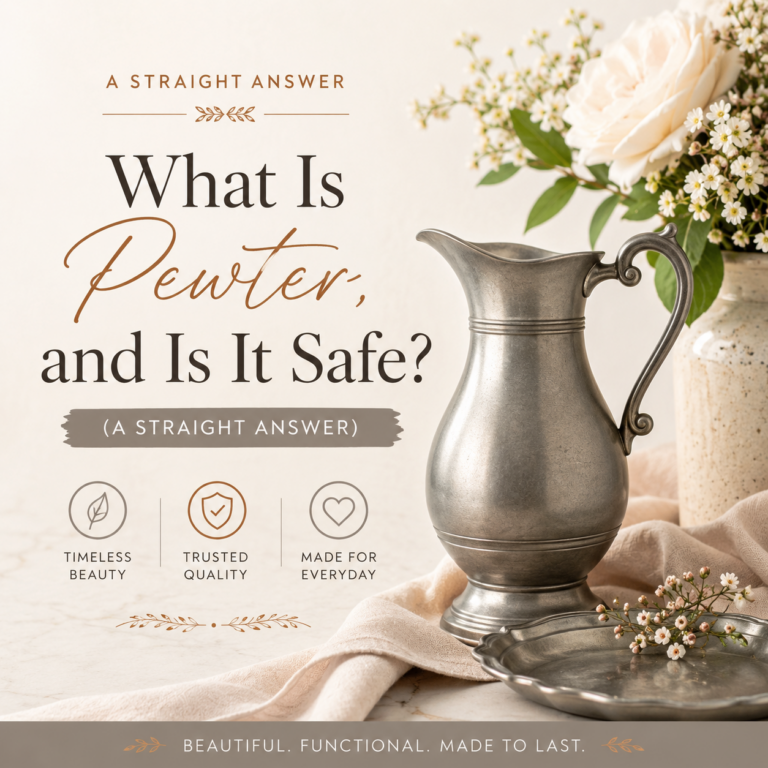
If you’ve ever picked up a pewter piece and wondered, even briefly, “wait — is this safe?” — you’re not being paranoid. Pewter has a genuinely complicated history, and the worry is rooted in something real. Here’s the actual answer, plus why we built an entire business around a metal a lot of people haven’t thought about since their grandmother’s china cabinet.
Pewter is a metal alloy — meaning it’s not one pure element, but a blend of several metals melted together. Modern pewter is overwhelmingly tin, typically 90–97% of the mix, combined with small amounts of antimony and copper. Those two additions aren’t filler — antimony hardens the metal and gives it brightness, while copper adds toughness so the finished piece can handle being clipped, unclipped, and carried around daily without losing its shape.
Pewter isn’t a modern invention dressed up to sound old. People have been casting it since the Bronze Age — the earliest known pewter piece was found in an Egyptian tomb dated to roughly 1450 BC. It’s a genuinely ancient material that happens to still be one of the best options available for small, detailed, handcrafted goods.
Here’s the honest, specific answer: old pewter often contained lead, and that pewter is not something you’d want in daily contact with skin or food. Modern pewter does not contain lead, and hasn’t for decades. The shift happened as lead’s health risks became well understood, and manufacturing standards caught up — modern pewter alloys swap lead out entirely in favor of antimony and copper, which do the same structural job without the toxicity.
A quick way to tell old leaded pewter from modern pewter, if you’re ever holding an antique piece and wondering: leaded pewter tends to develop a darker, almost black patina over time, while modern lead-free pewter ages to a softer gray. Every piece we cast at ForgedLynk uses modern, lead-free pewter — full stop, no exceptions, regardless of which product you’re looking at.
There are plenty of metals we could have built ForgedLynk around. Pewter won out for a few practical reasons that actually matter once you’re holding the finished piece:
It takes detail beautifully. Pewter has a relatively low melting point compared to most metals, which means it pours cleanly into intricate molds — the kind of fine detail you’d want in a name cast into a badge reel, or the stitching pattern on a tiny golf glove charm. Harder metals fight you on detail like that. Pewter doesn’t.
It develops character instead of looking worn out. Pewter naturally forms a soft gray patina with age and handling — this isn’t a flaw, it’s the metal doing what it’s always done. A pewter piece that’s been clipped to scrubs for two years doesn’t look beat up. It looks like it’s been used and loved, which is a different thing entirely.
It’s genuinely durable for daily-use items. This isn’t decorative tableware sitting in a cabinet — these are badge reels and golf markers that get handled constantly. Pewter’s hardness, thanks to that copper and antimony, holds up to exactly that kind of repeated daily use far better than the plastic alternatives most “badge reel” searches turn up.
A lot of personalized accessories on the market today — badge reels especially — get their personalization from printing or a sticker, applied after the piece is already made. It looks fine on day one. By month three, it’s peeling, faded, or scratched off entirely.
Every name, saying, or design on a ForgedLynk piece is cast directly into the metal — meaning it’s not sitting on top of the surface, it’s part of the surface. There’s nothing to peel because there’s nothing applied after the fact. The name on your badge reel will look the same the day you stop using it as it did the day you got it.
ForgedLynk started at trade shows years ago, where Paul — our fabricator — would set up a table of handcrafted pewter pieces and watch people stop and pick one up, surprised by how solid a small piece of metal could feel in their hand. Tens of thousands of pieces later, we’re bringing that same hand-cast, lead-free, built-to-actually-last approach online — badge reels, golf markers, and custom pieces, made the same way they always have been, just easier to find now than a trade show table.
If you’ve been hesitant about pewter because of something you half-remembered about lead — that worry was valid once, and it just doesn’t apply to what we make anymore.
Curious what handcrafted pewter actually looks like up close? Browse our full shop, or read more about our story.